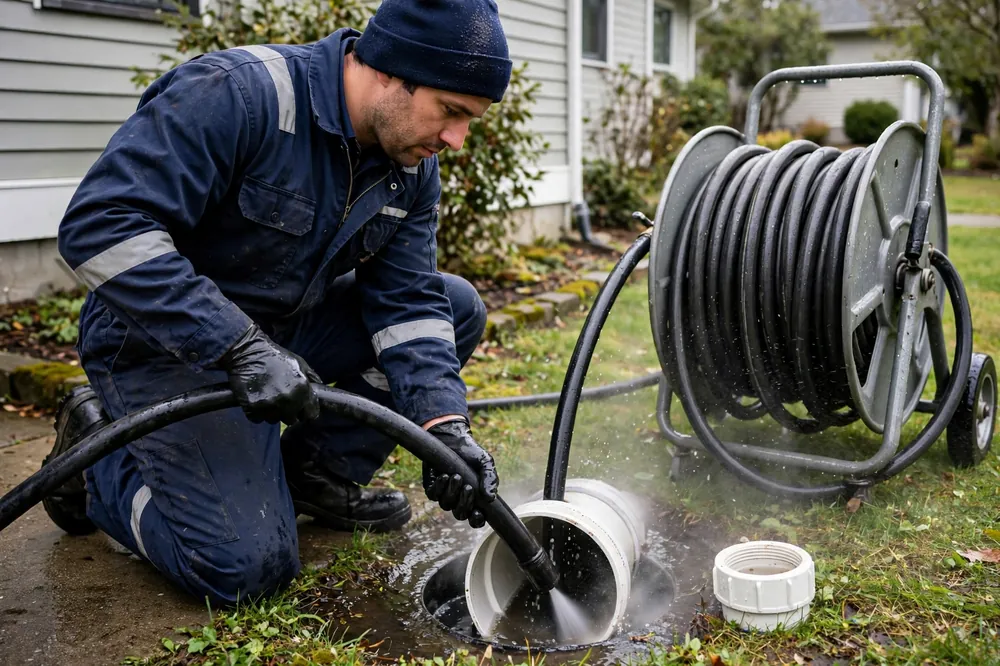
Ask three homeowners about their drain cleaning visit and you'll get three different stories, because "drain cleaning" covers everything from a quick sink auger job to a full day of hydro-jetting a root-choked main sewer line. If you're wondering what your drain cleaning will involve in Newark, DE, here's an honest breakdown of what actually shapes the job.
The short version: the scope follows the clog. Where it is, what it's made of, and what it takes to clear it for good, that's what determines the plan. Below are the six factors that shape every drain cleaning job, what a professional service should include, and how to make sure the plan you approve covers the work your drain needs. And the honest note first: every clog is different, so call (302) 412-8659 for clear options based on your specific situation.
Factor 1: Where the Clog Is Located
Location is the first thing a plumber assesses, because it determines the equipment and the effort. A clog in a single fixture's branch line, a bathroom sink, a shower, a kitchen drain, is the simplest case: short cable run, easy access through the drain opening or trap, usually cleared quickly. A clog in the main sewer line is a different job entirely: bigger equipment, longer cable runs, and often a camera inspection to find exactly where the blockage sits.
The telltale sign of a main-line problem is multiple fixtures acting up at once: toilets gurgling when the washer drains, water backing up in the tub when you flush. If that's what you're seeing, expect the job to involve more than a basic snaking, because the fix has to address the main line, not just one drain.
Factor 2: What the Clog Is Made Of
Not all blockages are created equal. Hair and soap scum in a bathroom drain clear easily with a standard snake. Kitchen grease is tougher: it coats pipe walls in layers, and punching a hole through it often isn't enough; the grease closes back up, and you're calling again in a month. Tree roots in a sewer line are tougher still: they require root-cutting heads, and they grow back unless the underlying pipe damage is addressed.
Then there's scale, the crusty mineral and corrosion buildup inside older cast iron pipe, which can narrow a pipe so much that standard snaking barely helps. And foreign objects (toys, wipes, sanitary products) each need their own approach. The material of the clog often determines the method, which brings us to the next factor.
Factor 3: The Method Required
A basic cable snaking clears many simple clogs and is the least involved method. Hydro-jetting, high-pressure water that scours the entire inside of the pipe, is a bigger job because it uses specialized equipment and more time on site, but for grease, scale, and roots it's the lasting fix rather than a temporary opening. A sewer camera inspection adds a diagnostic step, but for recurring problems it's what stops the same snaking from being repeated three times without finding the cause.
Think of it this way: the simplest method that actually solves the problem is the best job. A light snaking that leaves grease on the walls and lets the clog return in six weeks means more visits than one hydro-jetting that keeps the line clear. Ask what the method will accomplish, not just how quickly it can be done.
Factor 4: How Hard the Drain Is to Access
A drain with a convenient cleanout, an accessible capped pipe giving direct entry to the line, is quick work. No cleanout means the technician has to create access: pulling a toilet to reach the main line, working through a roof vent, or snaking through a fixture and hoping the cable makes the turns. Each workaround adds time and labor.
The work environment matters too. A cleanout in an open basement is easy; one buried behind storage, in a tight crawl space, or under a finished deck is slower going. Commercial properties add their own access challenges: grease traps, floor drains in kitchens, lines running under slabs. When two seemingly similar jobs call for different plans, access difficulty is often the hidden variable.
Factor 5: Emergency vs. Scheduled Service
Timing shapes the visit too. A sewage backup at midnight on a Saturday is an emergency call, the technician is coming out in the middle of the night, and the visit is handled as an urgent response. A slow drain you noticed on Tuesday and schedule for Thursday is a standard appointment.
This is the factor you control most. If the problem can safely wait until morning, a single slow sink, a drain that's sluggish but not backing up, scheduling a standard visit is the simpler path. If sewage is coming up through fixtures, that's not a wait-until-morning situation no matter the hour; call immediately.
Factor 6: One Drain or the Whole System
Clearing a single clogged sink is one job. Clearing a main sewer line that serves the entire house is a bigger one: more cable, more time, often a camera inspection to verify the full run is clear. And sometimes what looks like one problem is really a system problem: every drain in the house slow because of a main-line blockage, or recurring kitchen clogs because years of grease line the whole branch.
A good technician diagnoses the scope before recommending a plan. Be wary of a firm plan given over the phone for a problem nobody has seen: the scope determines the work, and the scope isn't known until someone looks.
What a Professional Drain Cleaning Should Include
Whatever the job, here's what a thorough visit covers when it's done right:
- Diagnosis first. The technician figures out where the clog is and what it's made of, not just where the symptom shows up.
- The right method for the clog. Snaking for simple blockages, hydro-jetting for grease and scale, root-cutting for roots, matched to the problem, not just the equipment on the truck.
- Verification. Water run through the line to confirm flow is restored, and a camera check for main-line or recurring issues, so you know it's actually clear.
- Clear plan first. You approve a written plan before work begins. No open-ended work, no surprise add-ons mid-job.
- Prevention advice. What caused this clog and how to keep it from coming back, because the best drain cleaning is the one you don't need twice.
If a plan seems unusually light, ask what's missing: no camera verification, no written scope, or a method that treats the symptom instead of the cause. The quickest fix that doesn't solve the problem is the one that brings the technician back.
How to Get a Clear Plan Before Work Starts
Start by describing the symptoms accurately: which fixtures are affected, how long it's been happening, whether it's getting worse, and whether you've had it cleared before. That helps the dispatcher send the right technician with the right equipment, which keeps the visit efficient.
When the technician arrives, ask for the diagnosis before the plan: where's the clog, what's it made of, and what method will clear it? Then get the plan in writing before work starts. For recurring clogs, ask whether a camera inspection makes sense, seeing inside the pipe is how you find roots, bellies, and breaks that snaking alone will never fix. And if the problem turns out to be in the main line, main sewer line service is a different job than a fixture drain, make sure the plan reflects the actual scope.
Keeping Future Clogs From Coming Back
The best drain cleaning is prevention. Most of the toughest jobs we see come from a few avoidable habits: grease poured down the kitchen sink, "flushable" wipes that don't break down, hair going down shower drains with no catcher, and tree roots left to grow into old clay or cast iron lines year after year.
Small changes, wiping pans before washing, a simple hair catcher, nothing but toilet paper in the toilet, prevent most fixture clogs. For the main line, homes with mature trees nearby or older pipe benefit from a periodic camera check; catching root intrusion early, when it's a maintenance jetting, is a far smaller job than dealing with it after a sewage backup. Express Drain Rescue serves Newark, New Castle, Bear, and surrounding New Castle County communities: call (302) 412-8659 for upfront options before any work begins.